

New Zealand is structurally better placed to survive the Iran war energy crisis than it was in the 1970s — and dramatically better placed than Australia. Here's the case for cautious optimism, and the roadmap to turn an advantage into true sovereignty.
In July 1979, the New Zealand government introduced carless days. Cars with odd-numbered plates could not be driven on certain days; even-numbered on others. The country had endured this before, in 1973, when the OPEC oil embargo sent shockwaves through every petrol-dependent economy on earth. New Zealand, having essentially no domestic oil production and no electricity generation that could substitute for transport fuel, was entirely at the mercy of distant events it could not control. People pooled rides. Buses overflowed. Some businesses shuttered early. The economy lurched.
Fast forward to today - March 2026. The US and Israel have struck Iran. The Strait of Hormuz — through which a fifth of the world’s oil trade transits — is largely closed. Petrol has crossed $3 a litre in Auckland, Wellington, and Christchurch. The government has stood up an emergency ministerial group. Shane Jones is invoking the spectre of Muldoon-era carless day legislation.
It sounds, on the surface, like the 1970s all over again. But it isn’t — and understanding exactly why it isn’t is crucial both for managing the current crisis and for making smart long-term policy. New Zealand has a structural energy advantage in 2026 that it simply did not possess in 1973 or 1979. The country has not fully capitalised on it yet. But the foundation is there.
The 1970s: Total Fossil Dependency, No Escape Hatch
To appreciate where New Zealand stands today, it helps to remember how naked the country was in 1973. Virtually all transport ran on petroleum. Electricity was heavily dependent on hydro, which was good — but hydro couldn’t power your car. There were no electric vehicles. There were no hybrids. There was no meaningful public EV charging network because there was nothing to charge. If oil stopped arriving, the economy ground to a halt in a near-linear, inescapable way. Every truck, bus, car, tractor, and aeroplane ran on refined petroleum, full stop.
The only lever available was demand destruction — simply using less. Carless days. Speed limits reduced to 80km/h. Early pub closures. Reduced street lighting. These were genuinely severe impositions that curtailed economic activity and daily life. There was no technological substitute waiting in the wings. You couldn’t “switch” to anything else. The country was hostage.
The Grid: New Zealand’s Extraordinary Structural Advantage
Here is the number that matters most in this conversation: in the fourth quarter of 2025, 96.4 percent of New Zealand’s electricity came from renewable sources. A record set just months ago, driven by strong hydro inflows and a 70 percent year-on-year surge in grid-scale solar generation. For the full year 2024, the figure was 85.5 percent, already extraordinary by global standards.
New Zealand’s electricity system is built on three foundations that are essentially impervious to the Strait of Hormuz: hydro, geothermal, and a fast-growing wind and solar sector. The hydro lakes of the South Island and Waikato are filled by rainfall and snowmelt. The geothermal fields of the Taupō Volcanic Zone produce steady baseload power from heat that has been building for millennia. Neither of these can be embargoed. Neither requires a ship from the Middle East. They are, in the most literal sense, sovereign energy — energy that belongs to New Zealand and cannot be cut off by any foreign power, port, or pipeline.
Compare this to Australia, which in 2024 still sourced 64 percent of its electricity from fossil fuels, with coal alone at 46 percent. Australia is a major coal exporter — it sits on vast reserves — and its grid was built on cheap thermal generation. That served Australia well economically for decades. But in an oil shock environment, it creates a cascading vulnerability: not only is transport almost entirely petroleum-dependent, but a large share of electricity generation is also fossil fuel-dependent, meaning there is no clean refuge to retreat to. New Zealand has that refuge. Australia, for most of its grid, does not.
NEW ZEALAND
96.4% - Renewable electricity, Q4 2025 (record). Annual average 85.5% in 2024. EV Fleet - 113K+ EVs on NZ roads in 2024, up from essentially zero in the 1970s. 100K+ new BEV/PHEV registered.
AUSTRALIA
36% - Renewable electricity in 2024. Coal still 46% of the mix. Fossil fuels 64% of generation. 91% - Fossil fuels as share of total primary energy mix in 2024. Transport almost entirely oil-dependent.
“New Zealand’s grid cannot be embargoed. Hydro lakes are filled by rain, geothermal fields by geology. No OPEC resolution touches them.”
The Electric Transport Buffer
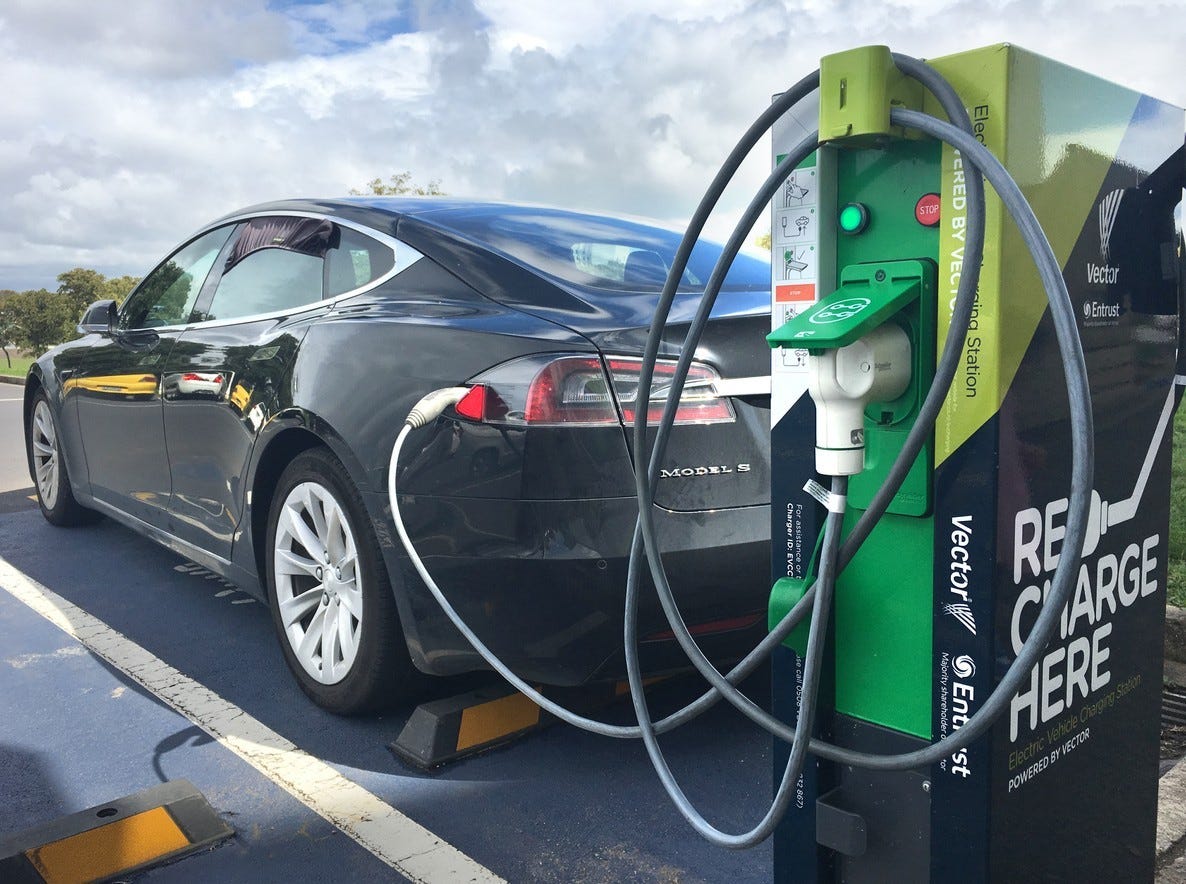
The 113,000-plus electric vehicles on New Zealand roads are not just a climate statistic. In a supply-constrained fuel environment, they are a genuine strategic asset. Every EV owner who charges at home overnight — drawing on that 85–96 percent renewable grid — is a household that has effectively decoupled its daily commuting needs from the global oil market. They are not queuing at petrol stations. They are not competing for the rationed diesel supply. In a crisis where demand destruction is being considered as a policy tool, EV owners have already done it.
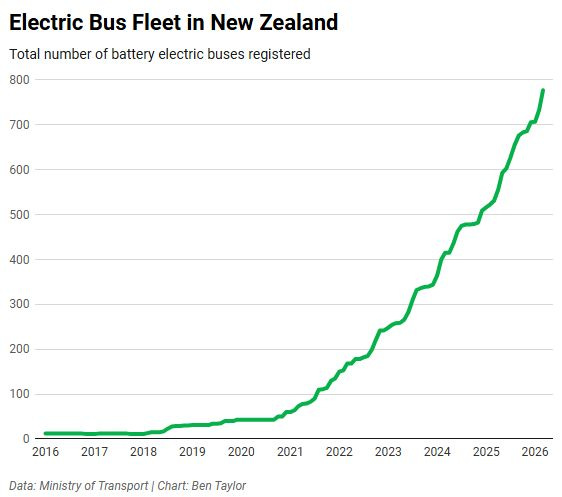
This effect is modest today, representing roughly 2–3 percent of the light vehicle fleet. But it is not nothing. And Zenobē and Ritchies are currently rolling out 172 electric buses across New Zealand — each one a diesel replacement that runs on sovereign renewable electricity. Electric urban buses represent a particularly high-value substitution because they run high daily kilometres, consume substantial fuel, and serve essential urban mobility functions that cannot easily be reduced during a crisis.
Rail — Auckland’s rapid transit network, Wellington’s commuter rail — both run on electricity. During the 1970s oil shocks, those trains were among the few forms of transport immune to the crisis. Today that immunity extends further: electric buses, e-bikes, and a growing fleet of private EVs all represent demand that simply does not compete for the diminishing supply of imported refined fuel.
New Zealand vs Australia: The Divergence
The contrast with Australia deserves more attention than it typically receives in the New Zealand media, which tends to benchmark the country against itself rather than against its nearest neighbour and largest trading partner.
Australia is, by almost every relevant energy security metric, more exposed to the Iran war than New Zealand. Its electricity grid still runs mostly on fossil fuels. Its transport sector is overwhelmingly petroleum-dependent. Its refining capacity, while partly subsidised to remain open, is thin — two refineries, sustained by government support. Australia imports refined fuel, but also imports a higher proportion of the energy that powers its electricity. In New South Wales alone, coal still generates nearly 60 percent of electricity. In Victoria, brown coal supplies 56 percent. These states cannot switch to electric transport in a crisis and breathe easier the way New Zealand increasingly can.
Australia is, however, moving fast on solar — faster than New Zealand in per-capita rooftop solar terms, where it leads the world. NZ’s advantage is in the nature of its renewables: hydro and geothermal are dispatchable, reliable, and storage-backed in a way that rooftop solar is not. When the sun doesn’t shine in Sydney, you need the gas peaker. When it doesn’t rain in Otago, New Zealand does face a dry-year challenge — but the geothermal base sits beneath that as a floor.
Despite NZ's grid advantage, transport accounts for roughly half of NZ's energy-related emissions, and is still almost entirely petroleum-dependent. The grid is clean; the roads mostly aren't — yet. That gap is the central challenge, and closing it faster is the central opportunity.
What New Zealand Must Do Next: The Electrification Roadmap
Being better positioned than the 1970s, and better positioned than Australia, is necessary but not sufficient. The Iran crisis is a forcing function. New Zealand has a window — opened by this crisis — to make decisions that would otherwise drift through bureaucratic inertia for years. Here is what that roadmap looks like:
Accelerate fleet electrification
Electrify the commercial and freight sector
Build out rural fast-charging infrastructure
Expand grid-scale battery storage to firm up the hydro system
Develop a domestic sustainable aviation fuel (SAF) pathway
Maximise onshore fuel storage as the short-term bridge
NZ has 620 million litres of unused storage capacity. Filling it — using government co-investment if necessary — extends New Zealand's crisis window from weeks to months, buying time for all of the above to compound.
The Deeper Point: Energy Sovereignty as Strategic Doctrine
There is a framing shift required here that New Zealand has not yet fully made. For decades, energy policy has been discussed primarily through the lens of climate change and emissions reduction. That framing, while legitimate, has political limits — it polarises, it generates backlash, it is easily painted as sacrifice. The Iran war offers a different framing: energy sovereignty. The proposition is not “drive an EV to save the planet.” It is “drive an EV and charge it from New Zealand’s own rivers and volcanoes, so that no war in the Middle East can strand you at a petrol station.”
These two framings lead to the same destination. But one of them has broad cross-party appeal in a way that climate policy rarely does. National Party voters who bristle at emissions targets have no particular objection to New Zealand being less dependent on foreign oil. NZ First voters who championed Marsden Point as a sovereignty issue should logically extend that reasoning to electrification. The alignment is there. It just needs a government willing to name it.
Australia’s situation reinforces the point. Australia’s fossil fuel abundance — its vast coal reserves, its LNG exports — has paradoxically made the energy sovereignty argument harder to prosecute politically. Why worry about energy security when you’re sitting on so much carbon? But that coal heats your electricity, not your petrol tank. In a liquid fuel shock, Australia’s coal reserves are irrelevant. New Zealand’s geothermal fields and hydro lakes, feeding into an electrifying transport fleet, are not. The small, resource-constrained island nation has, through a quirk of geology and decades of hydro investment, ended up with a more robust energy structure for the 21st century than its coal-rich neighbour, and most other countries in the world.
Seeby, this is very insightful and interesting. And beautifully written on a challenging topic......
Bro your living in the clouds 5 million petrol diesel cars today tomorrow we all change how there's no ships coming with oil la la land