I think this is one of the most insane things that the CIA has ever made public.
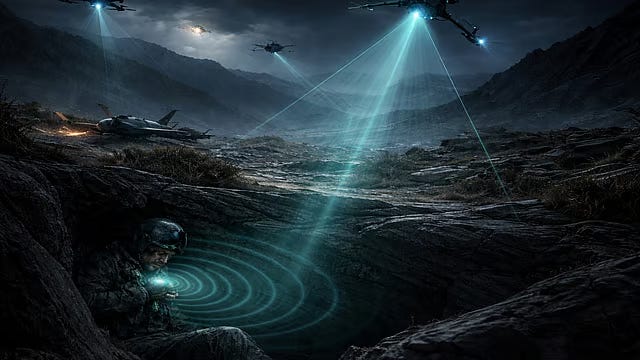
Last week the CIA used a classified tool called Ghost Murmur to locate a downed US airman hiding in a mountain crevice in southern Iran. He’d been there nearly two days, with Iranian forces actively searching for him. No phone signal. No working radio. Didn’t matter.
They found him from 40 miles away by detecting his heartbeat.
How it actually works
Ghost Murmur was developed by Lockheed Martin’s Skunk Works — the division behind the U-2 and SR-71 spy planes — and uses a field called quantum magnetometry. Specifically, sensors built around nitrogen-vacancy defects in synthetic diamonds, which are exquisitely sensitive to magnetic fields at room temperature.
Your heart generates a faint electromagnetic signature with every beat. That signal has always existed. The problem was separating it from background noise at any meaningful range. What changed is AI — the system pairs the diamond-based quantum sensors with machine learning that filters out terrain interference, atmospheric noise, and competing electromagnetic activity, isolating a single heartbeat signature across a vast search area.
The system reportedly works best in low-clutter environments — sparse terrain, low electronic interference, cool nights where thermal contrast helps confirm a biological target. Southern Iran’s desert mountains were apparently close to ideal conditions. The pilot briefly emerged from his hiding spot to activate a survival beacon; that exposure was apparently enough for Ghost Murmur to lock his position.
What this actually means
This was Ghost Murmur’s first known operational use, but it had been classified and in development for years prior. Trump confirmed the 40-mile detection range at a White House briefing. CIA Director Ratcliffe acknowledged “unique capabilities” without elaborating.
The practical implications are significant. Quantum sensing technology improves rapidly. What works at 40 miles in optimal desert conditions today will work at shorter ranges in more complex environments tomorrow. Unlike every other surveillance technology we’ve debated — phone tracking, facial recognition, metadata collection — there is no countermeasure for a heartbeat. You cannot turn it off, obscure it, or leave it at home.
The other thing worth noting: governments don’t disclose classified capabilities to impress people. They disclose them when the operational reality makes concealment impossible. This rescue was already public. Ghost Murmur was already the explanation. The disclosure was inevitable, not voluntary.
Which means whatever is sitting at the actual current frontier of this technology remains classified.
Quantum magnetometry is a genuinely fascinating field if you want to go deeper — the nitrogen-vacancy diamond sensor work coming out of places like MIT and Delft University has been extraordinary. This is just the first time it’s shown up in an operational military context.
The Sunday Guardian “The USA’s secret tool to save US airman”
Woo Woo thought of the day
Often science plays catch up. Very often science discovers a phenomenon that people dismiss as an old wives tale or with no scientific basis. Now that it’s public information that the CIA can detect your heartbeat from 40 miles away, is it really so strange to think that people may do the same?
There have been recorded instances of loved ones supposedly knowing when their partner or mother died - is it possible that our hearts are actually small radios, and that there really is some previously unknown mechanism by which we might be electrically or cosmically connected to other people’s hearts who we don’t know ?