

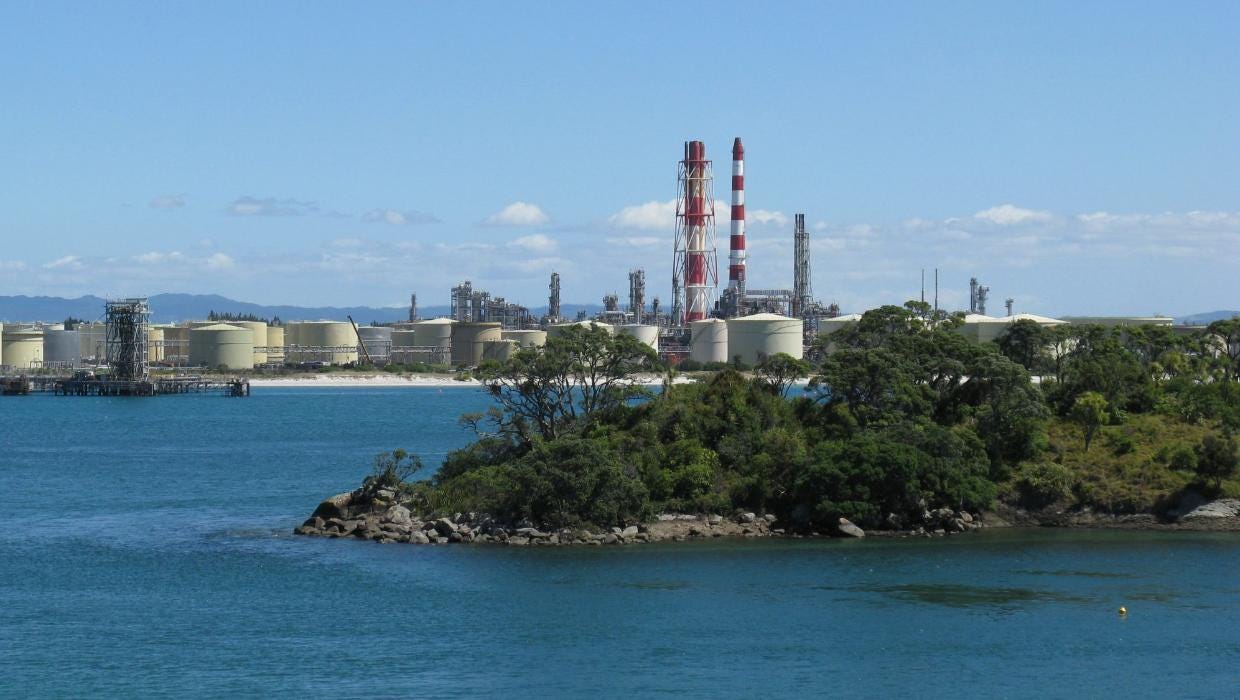
As the Iran war chokes the Strait of Hormuz and petrol tops $3 a litre, New Zealand is staring at the smouldering ruins of a decision it made just four years ago. A strategic post-mortem — and a hard look at what comes next.
On 31 March 2022, the last flame at Marsden Point went out. New Zealand’s sole oil refinery — a facility that had run continuously since 1964, that had supplied the majority of the country’s refined fuel, that had produced the bitumen holding together our roads, and that had, by some accounts, once attracted Australian Air Force tankers halfway across the Tasman to fill up on the quality of its jet fuel — was converted into an import terminal.
Within months, the decommissioning crews moved in. Cables were cut at the ground. Heat exchanger bundles were stripped out for recycling. Today, the towers are cold and silent, tanks labelled “Brent Crude” sit empty, and health and safety lanyards still read “Refining NZ” — a ghost of an institution that no longer exists.
Then, on 28 February 2026, the United States and Israel launched coordinated large-scale strikes inside Iran. Within hours, ballistic missiles and drones rained down on US bases in Saudi Arabia, Qatar, Bahrain, Kuwait, and the UAE. Iran announced the closure of the Strait of Hormuz. Where 80 tankers once transited daily, now one or two dare the passage. Petrol in Auckland, Wellington and Christchurch has crossed $3 a litre. Air New Zealand has suspended its earnings guidance. A freight company reports road transport fuel surcharges up more than 30 percent. The government has stood up an emergency ministerial group publishing daily situation reports. And economists are warning that, if the disruption drags on, New Zealand may have around 17 to 18 days of fuel on shore by the time the ships currently at sea actually arrive.
In this context, a question that seemed purely academic just months ago has become urgent: could New Zealand restart the Marsden Point refinery?
The numbers right now
NZ has approximately 45–50 days of fuel including stock on water. Shore-side stocks alone could sustain roughly one month under rationing. Petrol prices have exceeded $3/litre nationwide. The IEA has announced a record 400 million barrel strategic reserve release. South Korea, NZ’s primary fuel supplier, has pledged to limit — not stop — exports. The government is considering invoking Muldoon-era carless day legislation. Working from home reminiscent of the COVID era seems extremely likely in the near future.
What Marsden Point Actually Was — and Why It Mattered
Marsden Point was not merely a refinery. It was critical national infrastructure, producing around 70 percent of New Zealand’s refined fuel needs from a medium-sour crude blend, mostly imported from the Middle East. It produced petrol, diesel, jet fuel, and — critically — bitumen for roading. That bitumen point deserves more attention than it typically receives. New Zealand is now importing an expensive, inferior bitumen substitute from overseas to rebuild roads that Marsden once supplied domestically. That loss is tangible, daily, and monetary, embedded in every pothole contract the NZTA signs.
Then there is the jet fuel story. It is anecdotal, and warrants the caveat of oral history, but veterans of the industry recall Australian Air Force aircraft making the trip to New Zealand specifically because the quality of Marsden’s jet fuel was notably superior to what was readily available across the Tasman. Whether this involved formal procurement arrangements or simply represented quality arbitrage by procurement officers is unclear, but it speaks to a refinery that operated at a high technical standard — one that had been upgraded extensively through the early 1980s Think Big programme, including a hydrocracker and 170-kilometre pipeline to Auckland’s Wiri terminal. The pipeline — the Refinery-Auckland Pipeline, or RAP — remains. It is one of the few truly valuable pieces of infrastructure that survived the shutdown, running 168 kilometres underground to Auckland.
Who Actually Closed It — Setting the Political Record Straight
Much of the political energy surrounding Marsden Point has been directed at the Labour government that was in power at the time of closure. Labour has carried the political blame in the popular imagination, and it is true that the government of the day provided no support — financial or political — to keep the refinery operating. But the decision to close was not made in the Beehive. It was made in the boardrooms of Z Energy, BP, and Mobil — the three largest shareholders in what was then called Refining NZ, together holding a collective 42 percent of the business. Their vote to convert the site to an import terminal was nearly unanimous.
The commercial logic was coldly rational: cheap refined product from large Asian refineries in Singapore and South Korea had been undercutting Marsden’s economics for years. The pioneering work of challengers like Gull in importing refined fuel at lower cost had already proved the model. When refining margins collapsed in the post-COVID excess-capacity environment, the shareholders simply decided they could source fuel more cheaply offshore than manufacture it domestically. The government of the day acquiesced, reassured by oil company promises that resilience would actually be enhanced by diversification — by no longer depending on a single domestic refinery.
“Closing a refinery is not mothballing it. There is no big green lever.”
— Rob Buchanan, CEO, Channel Infrastructure, 2024
That argument has aged very poorly indeed.
The Brutal Technical Reality of Restart
Here is where optimism must collide with engineering. The Marsden Point site was not mothballed. It was decommissioned — and the distinction is everything. By mid-2022, more than 70 percent of the decommissioning was already complete. All cabling had been cut at ground level. Heat exchanger bundles had been shipped offsite for recycling. By 2024, the process was finished. Channel Infrastructure CEO Rob Buchanan has been unambiguous: “There is no part of the former refinery that can be restarted. There’s no big green lever.” Rebuilding refinery operations would cost, by his estimate, billions of dollars — without formal costings having even been undertaken — and would take a number of years.
Compare this to what is sometimes presented as the counterfactual: a refinery in Iran or Saudi Arabia that has been bombed. The argument goes that New Zealand’s decommissioned facility is in better shape than a bombed-out Middle Eastern plant. This is partially true in one narrow sense — the physical site and its storage infrastructure are intact, the RAP pipeline remains operational, and Channel Infrastructure’s new jet fuel tanks are brand new and functioning. But the process equipment that turns crude oil into refined products — the distillation columns, the hydrocracker, the catalytic units, the heat exchangers — is gone. The control systems are gone. The specialist workforce has dispersed. You are not restarting a sleeping refinery. You are building a new one on a brownfield site. The timeline from decision to first barrel of fuel would conservatively be five to seven years, even with political will and unlimited capital.
ARGUMENTS FOR RESTARTING MARDEN
RAP pipeline to Auckland intact & operational
Existing port and deepwater infrastructure
Storage tanks and new jet fuel facilities on site
Brownfield site with consenting history
Removes single-point-of-failure in import dependency
Restores local bitumen production
Hedges against prolonged Hormuz closures
Sovereign capability for defence fuel quality
Potential SAF / hydrogen transition platform
ARGUMENTS AGAINST / OBSTACLES
Process equipment fully stripped and recycled
Specialist workforce has dispersed globally
Estimated rebuild cost: billions of NZD
Timeline to first barrel: 5–7 years minimum
NZ crude is light-sweet, exported; Marsden ran on imported medium-sour
Economics still unfavourable vs large Asian refineries in peacetime
Capital competing with hospitals, housing, roads
Private shareholders have no incentive without subsidy
Does nothing to help the crisis unfolding right now
The Iran War Context: Does It Change the Calculus?
The short answer is: not for the immediate crisis — but potentially yes for the strategic long term.
For the current emergency, restarting Marsden Point is irrelevant. The timeline makes it so. New Zealand’s focus must be on managing existing stocks, securing inbound shipments from South Korea and Singapore (both of which still have supply lines, even if under strain), activating IEA reserve entitlements, and potentially rationing demand. Those are the levers that matter in the next 30 to 90 days.
What the Iran conflict does change is the political economy of the longer-term argument. For years, the case for domestic refining was dismissed as nostalgic economics — a refusal to accept that comparative advantage meant buying refined fuel cheaply from large Asian refineries. That argument assumed a stable, open global trading system in which the Strait of Hormuz would remain navigable. It assumed that South Korea and Singapore would not restrict exports to protect their own populations — an assumption already under stress, with China having asked refiners to suspend fuel exports and South Korea implementing domestic price caps. New Zealand’s geographic isolation, which in peacetime is a minor inconvenience, becomes a strategic liability when shipping lanes close.
The Dependancy Chain
NZ’s fuel comes from refineries in South Korea and Singapore → those refineries import crude via the Strait of Hormuz → the Strait is now largely closed → South Korea is implementing domestic price controls → the chain has three fragile links, and NZ sits at the end of it.
Furthermore, the Iran conflict has demonstrated — with considerable force — something that energy security analysts have been saying for years: the 20 percent of global oil trade transiting Hormuz is not a theoretical vulnerability. It is a real one. The IEA’s record 400-million-barrel reserve release is the largest in its history. Crude prices have crossed $100 per barrel for the first time since 2022. Air New Zealand’s jet fuel crack spread has gone from $22/barrel pre-conflict to $115/barrel. These are not ordinary market fluctuations. They are structural shocks.
What should New Zealand actually do?
The honest answer is that New Zealand cannot restart Marsden Point in any timeframe relevant to this crisis or any crisis in the next decade without spending an extraordinary amount of money it would struggle to justify against other public priorities. But that is not the only option, and the binary choice between “restart the refinery” and “do nothing” is a false one.
The most immediately actionable intervention is dramatically expanding onshore fuel storage. Channel Infrastructure currently has close to 900 million litres of storage capacity, but only about 280 million litres — roughly a third — is utilised. Filling that unutilised capacity would extend New Zealand’s buffer from weeks to months. The capital cost is a fraction of refinery reconstruction. This is not a novel idea: MBIE’s own National Fuel Plan identifies it, and Channel Infrastructure’s CEO has explicitly flagged the company’s willingness to expand storage where government investment supports it. This should have been done in 2022. It must happen now.
Second, New Zealand should use the Marsden Point site’s surviving infrastructure as the foundation for a genuine energy transition precinct — one that could include synthetic aviation fuel (SAF) production, green hydrogen, and methanol import capability. These are not fantasy projects; they are already being evaluated by Channel Infrastructure. A refinery-equivalent that processes low-carbon feedstocks rather than crude oil preserves the sovereign processing capability that Marsden once represented, without betting the farm on petroleum economics that may be structurally declining over the next two decades.
Third — and this is a hard conversation — New Zealand needs a formal strategic petroleum reserve. Australia was already subsidising its last two refineries to remain open until around 2030. New Zealand had no such instrument. The IEA framework gives New Zealand entitlements to reserves held in the US, UK, and Japan, but as the current crisis demonstrates, accessing those stocks takes time, coordination, and diplomatic goodwill. Sovereign stockpiles held in-country are qualitatively different.
Fourth, diversification of supply origins. South Korea and Singapore account for the overwhelming majority of New Zealand’s refined fuel imports. The risk of simultaneous export restrictions from both — already nonzero — deserves a supply chain response: qualifying additional suppliers in India, Japan, and potentially even Australia’s remaining refineries, maintaining active relationships with multiple sources at all times.
The Verdict: A Preventable Strategic Failure
Marsden Point cannot be restarted in any timeframe relevant to the current or near-future crisis. The decommissioning was not a mothballing — it was a demolition. Rebuilding would cost billions and take years. But the Iran conflict has proven, definitively and expensively, that the arguments used to justify the closure were dangerously complacent. The single actionable priority right now is maximising onshore storage. The medium-term priority is an SAF/energy precinct at Marsden to preserve sovereign processing capability in a post-crude world. And the long-term lesson is that in energy security, the cheapest-option logic of peacetime is a luxury that small, isolated nations at the end of long supply chains cannot always afford.
It is worth naming, without rancour, what actually happened here. The shareholders of Refining NZ — among them BP, Z Energy, and Mobil — made a commercially rational decision that happened to leave New Zealand geopolitically exposed. The Labour government of the day failed to recognise the national security dimension of that commercial decision, and provided neither financial support to keep the refinery operating nor a serious plan for the vulnerability its closure would create. The subsequent National-NZ First coalition government commissioned a feasibility study into reopening — a study whose conclusions, once the full decommissioning reality became clear, were essentially predetermined. And then the Iran war arrived, early, and New Zealand found itself with 45 days of fuel, $3 petrol, and a cold, stripped refinery site in Northland.
The pipeline to Auckland still runs. The port still works. The land is still there. Those are real assets, and they represent the starting point for something — just not, in any near-term scenario, a crude oil refinery. The question for New Zealand now is whether it has the strategic imagination to turn what remains of Marsden Point into the energy infrastructure the country will actually need in 2035 — or whether it will spend the next decade debating a restart that cannot happen while the real opportunities pass it by.
The steam towers at Marsden Point are cold and rust is setting in on the old pipes. But the site has a pipeline to Auckland, a deepwater port, and a government that is finally, painfully, taking energy security seriously. That is a foundation. Whether New Zealand builds something meaningful on it — or keeps arguing about the lever that no longer exists — is the strategic question of the decade.
Nice summary, Seeby. However the underlying assumption that we need to support the NZ economy with fossil fuels to the same extent as previously is flawed. Just as Bill Birch used the oil crises of the 1970s & 80s to kick start developments in a new direction we shouldn’t, as every politician knows, let this crisis pass without exploiting it as an opportunity to get off the fossil fuel drug.
Thanks a good summary. What unpins the rational economic arguments? This is where our belief in markets falls short. Markets attempt and are sometimes successful at the narrow goal of efficient allocation of capital. They do not and will never optimise for resilience. JIT supply chains, are economically efficient (based on a narrow boundary) but turn out to be very brittle, Covid reminded us of that. But my hunch would be that virtually no company that experienced a supply chain issue during Covid has done anything different since, all acting “rationally”.